

🌟 New Year Offer 🌟
Celebrate 2026 with 30% OFF on all products! Use code: NEWYEAR2026. Hurry, offer ends soon!
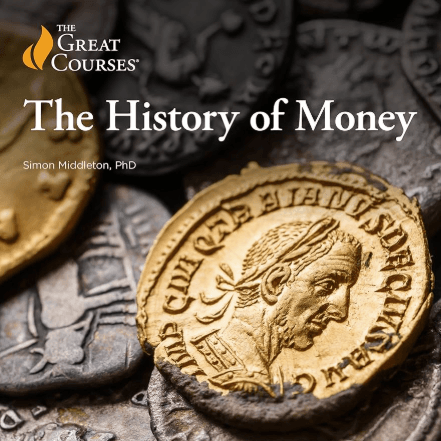
Uncover the fascinating 5,000-year evolution of currency and credit with Dr. Simon Middleton’s comprehensive 18-lecture journey through the history of money.
From ancient clay tokens to the rise of cryptocurrency, master the economic forces and historical events that continue to shape our global financial world.
File Size: 8.307 GB.
Format File: 18 MKV + 1 PDF
The Great Courses – Simon Middleton – The History of Money (2025)
Simon Middleton, PhD
“Money, in whatever form it’s taken, has been a central feature of our social and economic existence since the dawn of civilization.”
Institution: William & Mary
Alma mater: The City University of New York
Simon Middleton is a William E. Pullen Associate Professor of History at William & Mary. He received his PhD in History from the City University of New York Graduate Center, and he specializes in early American social history and political economy. His publications include the book From Privileges to Rights: Work and Politics in Colonial New York City and articles in the William and Mary Quarterly and Early American Studies.
Overview
Few concepts are as essential yet elusive as money. We use it every day, but rarely pause to ask what it really is, why it takes the forms it does, or how it achieves and retains value. “Money makes the world go round,” goes one saying. But, at times, it makes the world go crazy, too!
Therefore, it’s vital to understand money and how it works. The History of Money immerses you in this fascinating subject in 18 half-hour lectures taught by moneyman of letters Simon Middleton, Associate Professor of History at the College of William & Mary and an expert on American economic history. Professor Middleton follows money’s evolution across the centuries—from philosophers and rulers to swindlers and reformers, from market panics to multinational intrigues.
He opens with clay tokens and early credit systems. Then, he moves through Roman coinage and medieval banking and shows how new ways of creating and controlling money fueled empires and sparked revolutions. Along the way, you meet remarkable figures—among them John Law, Adam Smith, Karl Marx, John Maynard Keynes, and Milton Friedman.
It’s no secret that the American Revolution was incited by a money dispute—namely, British taxes. You discover the prominent role of finance in US history—from the controversy over the Bank of the United States during the Jackson administration, to the banking wizardry required to pay for the Civil War, to the Great Depression and more recent financial crises. Indeed, America’s history is written in dollars and debts.
18 Lectures
01 – What Is Money?
(29 min)
We say money “makes the world go round,” but what is money? Start the course with the essential properties that make money work. Economists gained surprising insight from the Pacific island of Yap, where giant stone discs—even one on the ocean floor—served as currency for the local people. Discover how they grasped a crucial feature of every successful monetary system: shared belief in value.
02 – How Did Money Get Started?
(31 min)
An oft-told tale is that money evolved to replace inefficient barter. But the truth is more complex. Travel back thousands of years to learn how writing emerged to record stores of commodities. Clay tokens of different shapes and denominations physically represented units of value and obligation. And, eventually, precious-metal coins were introduced as an inherently valuable medium of exchange.
03 – Money and the Rise and Fall of Rome
(35 min)
Rome dominated the Mediterranean world for many centuries. Its power rested not only on military strength, but also on a financial system built around stable, widely accepted coinage, state control of precious metals, and a vast network of taxes and tribute. Ultimately, mounting administrative costs, political instability, and the debasement of currency led to the empire’s disintegration.
04 – Money in the Early Medieval Era
(33 min)
After the fall of Rome in the West, coin-based economies largely collapsed. In places like early medieval England, exchange reverted to gift-giving and reciprocal obligations among lords and vassals. Over time, old Roman and foreign coins reentered circulation, paving the way for locally minted coinage—an innovation driven by expanding markets, long-distance trade, and the need for portable value.
05 – China and the Great Divergence
(33 min)
In China, money was more than a medium of exchange—it was a tool of governance. The state minted coins, set exchange rates, and used currency to shape commerce and enforce social order. This centralized approach culminated in a remarkable innovation: the world’s first government-issued paper money, which left Italian traveler Marco Polo (circa 1274) marveling centuries before Europe caught up.
06 – Renaissance of Money: From the Templars to Banking
(33 min)
Trace the rise of credit, transfer systems, and international finance in Europe—from the key role of the Knights Templar during the Crusades to the emergence of powerful medieval banking families. Amid near-constant warfare and monetary chaos, philosopher Nicolas Oresme proposed reforms to the French king—marking a turning point toward currency stability and Europe’s economic resurgence.
07 – A New World of Money
(33 min)
The age of European colonization brought financial innovation and confusion. Spain’s flood of Peruvian silver destabilized prices across Europe. In North America, English colonies—short on coin—used local goods like tobacco as “current money,” creating a patchwork of regional standards and values. The result was a complex, often unstable system of exchange throughout the colonial world.
08 – England’s 17th-Century Money Troubles
(34 min)
Survey England’s monetary turmoil in the 17th century, as royal control of coinage gave way to a new system centered on the Bank of England, which was empowered to issue notes backed by public credit. Amid religious upheaval and economic strain, thinkers like William Petty reimagined money as credit and trust, laying the foundation for modern public finance and paper currency.
09 – South Sea and Mississippi Bubbles Burst in the 1700s
(32 min)
The new approach to money, anchored on a semi-independent central bank, appeared miraculous—promising limitless economic opportunity. But the collapse of Britain’s South Sea Bubble and France’s Company of the West—both tied to speculation in the Atlantic slave trade—shattered that illusion. These failures reinforced the landed aristocracy’s doubts about paper money and credit-based finance.
10 – A Revolution of Money
(36 min)
Contrast England’s bank-centered financial system with France’s old-school reliance on royal control over money. In French eyes, England (and especially its freewheeling American colonies) seemed headed for financial ruin. Meanwhile, Enlightenment debates about trust and power helped fuel colonial resistance to British monetary limits, turning a tax dispute into a full-blown revolution.
11 – An American Nation of Counterfeiters
(35 min)
Building on Adam Smith’s influential ideas about the nature of money, chart US fiscal policy from Alexander Hamilton’s post-Revolution reforms to the economic clash between western farmers, eastern merchants, and southern slaveholders. Rampant counterfeiting eroded trust in the system, escalating the tensions that ultimately erupted in the financial and political crisis of the Civil War.
12 – From Burke to Paine: Ideas about Money
(33 min)
Adam Smith’s economic theory launched modern economics and the search to understand why his idealized vision fell short, with wealth concentrating among investors and elites. Thinkers from Edmund Burke and Thomas Paine to Karl Marx and the Austrian school of free-market theorists offered sharply different answers, sparking arguments over how markets work and who benefits from economic growth.
13 – Money Divides America: From the Civil War to the Fed
(33 min)
Contrast the monetary policies of the North and South during the Civil War, which arguably won the war for the Union. Then, follow the postwar bimetallism debate as farmers and laborers clashed with gold-standard bankers during the Gilded Age. Learn how these tensions fueled the Progressive push for reform—culminating in the 1913 creation of the Federal Reserve to stabilize currency and credit.
14 – From the Great War to the Great Crash
(33 min)
Trace the turmoil from World War I’s crushing debts and reparations to the uneasy peace that followed. Economist John Maynard Keynes warned that the punitive settlement and rigid gold standard invited collapse. Meanwhile, the Communist Revolution in Russia offered a seemingly egalitarian alternative, as nations lurched between inflation and austerity—setting the stage for the Great Depression.
15 – Financial Collapse: The Great Depression
(33 min)
Consider rival theories for the causes of the Great Depression. Investigate why this downturn lasted a decade, not a year or two common for most recessions. Examine President Hoover’s ineffectual response, followed by Roosevelt’s evolving strategies for restoring prosperity—from banking reform and New Deal relief programs to a partial embrace of Keynesian stimulus. Also, look at responses abroad.
16 – The Neoliberal Turn: From Bretton Woods to Nixon
(33 min)
The Bretton Woods agreement at the end of World War II set the stage for 25 years of unparalleled economic growth. Trace its unraveling through the oil shocks and stagflation of the 1970s—culminating in Nixon’s end to gold convertibility for foreign holdings. Examine how the Reagan-Thatcher revolution embraced free-market reforms, fueling globalization and the era of “turbocapitalism.”
17 – On Borrowed Time: The 2008 Financial Crisis
(32 min)
After the Cold War, liberal capitalism was hailed as history’s final triumph. Deregulation under Presidents Clinton and Bush fueled a lending frenzy, with exotic financial instruments disguising mounting risks. When the Great Recession hit in 2008, it was widely blamed on the US subprime mortgage market—but it was really an international house of cards, collapsing as major banks began to fail.
18 – The Future of Money: From Austerity to Crypto
(37 min)
Chart events leading up to the Great Recession and the measures that kept it from becoming another Great Depression. Massive taxpayer-funded rescues may have been essential, but they entrenched the “bailout state” and fueled skepticism of traditional finance, spurring innovations like cryptocurrency. Conclude by exploring what these shifts may signal for the next chapter in the story of money.
Course Features
- Lecture 0
- Quiz 0
- Duration 10 weeks
- Skill level All levels
- Language English
- Students 53
- Assessments Yes