
🌟 New Year Offer 🌟
Celebrate 2026 with 30% OFF on all products! Use code: NEWYEAR2026. Hurry, offer ends soon!
There are many therapeutic options available for traumatized people, who in a variety of ways react to past experiences as a replay of the present. These methods do not rely on drugs or cognition.
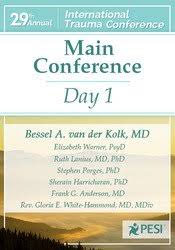
Bessel Van der Kolk , Elizabeth Warner – Bessel A. van der Kolk’s 29th Annual Trauma Conference, Main Conference Day 1
(*1*)
The study of trauma is the most important area for understanding the interplay between the biological, cognitive and emotional forces that influence human development. Let’s start with post-PTSD in adults and growing into attachment in childhood and overwhelming attachment in adulthood.“Developmental Trauma”This endeavor has clarified how certain experiences can be elucidated. “set” Psychological expectations and biological selectivity
There is a need to find therapeutic methods that don’t rely on drugs or cognition when dealing with traumatized individuals who, in many ways, react to the present experience as a replay. We know that most experience is processed at the subcortical level in the brain. “unconscious” Interpretations that occur outside of conscious awareness. Understanding and insight only have a limited effect on the operation these subcortical processes. Synchrony, movement, and reparative experiences have a greater influence.
Workshops are included in this recording
- Trauma Embodied Cognition – Bessel A. van der KolkMD
- The effects of traumatizing stress on the self-Experience: Balance, Perception & Sensory Integration – Sherain Harricharan, PhD, Elizabeth Warner, PsyD & Ruth Lanius, MD, PhD
- The Psychological Processing of Traumatic Experiences: Self-Awareness, Interoception & Memory Processing – How (and How Well) Does EMDR Actually Work? – Ruth LaniusMD, PhD, Matthew Sanford & Bessel A. van der Kolk, MD
- The Craving Mind: Why We Get Stuck in Habits & How Mindfulness Helps Us Get Unstuck – Judson B. Brewer, MD, Ph.D
- Panel Discussion & Questions
- The Emergence of a Polygonal-Informed Therapy: How Music & Voice Contribute to Healing Following Trauma – Stephen W. Porges, PhD
- Internal Family Systems and Psychotherapy of Self-Leadership: Self and Identity – Richard C. Schwartz, PhD
- This article will provide an overview of the effects of trauma on the brain, body, and nervous system.
- Examine the effects of extreme stress on the brain and examine the nature of traumatic stress.
- Explain how EMDR is used to process trauma memories and how it relates in clinical practice.
- Find out how habits are formed and why they can be so difficult to overcome. Also, find out the latest research that can help clients believe that habits can be changed.
- Discuss the foundation of Polyvagal Theory in relation to the clinical treatment for trauma.
- Implement the IFS model in your clinic to speed up healing for clients with PTSD.
- To aid in assessment and treatment planning, identify, clarify and clarify the protective aspects of clients with trauma histories.
Would you like a gift? Bessel Van der Kolk , Elizabeth Warner – Bessel A. van der Kolk’s 29th Annual Trauma Conference, Main Conference Day 1 ?
Trauma Embodied Cognition – Bessel A. van der KolkMD
- What Trauma It looks like
The effects of traumatizing stress on the self-Experience: Balance, Perception & Sensory Integration – Sherain Harricharan, PhD & Elizabeth Warner, PsyD
- The Importance and Value of Balance in the Body
- Understanding the Vestibular system and its Relationship to it Trauma
- Manifestation of Vestibular Neural Circuitry
- Healthy Child Development through the Vestibular System
The Psychological Processing of Traumatic Experiences: Self-Awareness, Interoception & Memory Processing – How (and How Well) Does EMDR Actually Work? – Ruth LaniusMD, PhD, Matthew Sanford & Bessel A. van der Kolk, MD
- EMDR vs Fluoxetine vs Placebo Study Results
- The Foundation to the Sense of Self
- Understanding the Mental Time Traveler
- The Neuroscience and Eye Moments
The Craving Mind: Why We Get Stuck in Habits & How Mindfulness Helps Us Get Unstuck – Judson B. Brewer, MD, Ph.D
- Understanding Addiction’s Mind
- Reward yourself and others
- Mindfulness and Addiction: A Behavioral and Biological Perspective
- Awareness is Essential
- Video Demonstrations and Case Studies
Panel Discussion & Questions
The Emergence of a Polygonal-Informed Therapy: How Music & Voice Contribute to Healing Following Trauma – Stephen W. Porges, PhD
- An Introduction to Polyvagal Theory
- The power and importance of voice, music and listening
- Understanding Frequency and Their Impact on Traumatized Persons
- Video Demonstrations and Case Studies
Internal Family Systems and Psychotherapy of Self-Leadership: Self and Identity – Richard C. Schwartz, PhD
- How Internal Family Systems were Developed
- Introduction to the Multiple Parts and Self
- The 8 C’s of Self-Leadership
- The IFS Model’s Two Big Realities
- The Map of Internal Family Systems
- Understanding the Different Roles Our Parts Play
- Clinical Practice: Internal Family Systems
Course Features
- Lecture 0
- Quiz 0
- Duration Lifetime access
- Skill level All levels
- Language English
- Students 0
- Assessments Yes