
🌟 New Year Offer 🌟
Celebrate 2026 with 30% OFF on all products! Use code: NEWYEAR2026. Hurry, offer ends soon!
Heal deep-seated family wounds and master the complex dynamics of father-son relationships through this powerful psychological breakdown of “The Judge.”
Discover the courage to remain true to yourself while navigating the thin line between justice, resentment, and profound personal transformation.
File Size: 5.616 GB. Format File: 2 MP4.
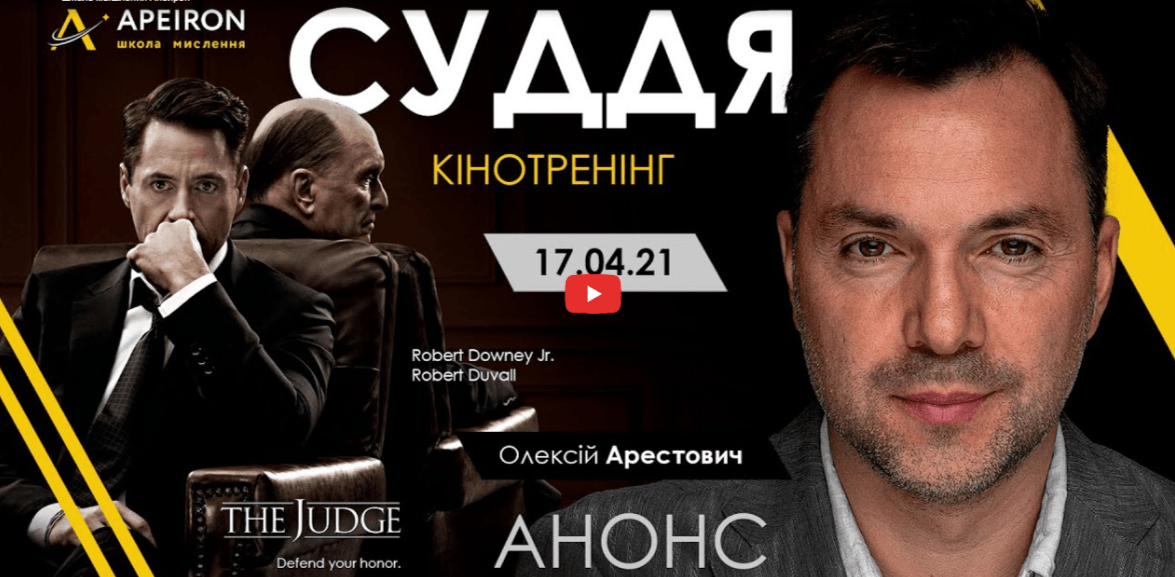
Alexey Arestovych – Psychological training based on the analysis of the film The Judge

An analysis of the film “The Judge” will reveal the essence of the action of The Sacred Wound in the context of a father-son relationship complicated by a trial, family baggage, and deep ideological differences on the topic of “to be or to give up,” while revealing that reality is often the opposite of external perceptions.
Video announcement
More about the classes
Film seminar on the film “The Judge” with Oleksiy Arestovich: illustration of the work “Sacred Wound” using the example of human relationships
At the film seminar, we will delve into the analysis of the dramatic and moral-ethical film “The Judge” (2014) by director David Dobkin.
The masterfully played characters of Robert Downey Jr. and Robert Duvall embody the complex characters of father and son, and judge and lawyer.
Main themes and conflicts
An analysis of the film “The Judge” will reveal the essence of the action of The Sacred Wound in the context of a father-son relationship complicated by a trial, family baggage, and deep ideological differences on the topic of “to be or to give up,” while revealing that reality is often the opposite of external representations.
The plot of the film
The plot is based on the influence of the attitude – do not show your true feelings, otherwise you will be ridiculed and humiliated. The conflict that tears us apart from the inside is that we simultaneously want to show our true “self” and hide it as far as possible so that it does not get trampled – along with us.
It’s a dilemma, but the dilemma takes on an especially acute resonance when the person you’re portraying success to is your father, who remembers you as a little boy and knows all your secrets and weaknesses.
Downey Jr. portrays a successful, ruthless lawyer and playboy, and it’s not hard for him, because he really is a successful lawyer and playboy.
But his father, having put him, his own son, in prison as a green, 17-year-old boy, knows his main secret: he is a little boy who, in his bravado, did irreparable, terrible things, crippling his own family, then was pushed away by them and lives with a huge, black, never-healing hole in his soul, torn apart by guilt, anger, and resentment toward his father, which cannot be quelled by any success, real achievements, or strength of character.
The outstanding drama of this story lies in the fact that circumstances place the father-judge before the same choice as his son: to be or to surrender?
A judge who has become a symbol of honor and impartiality in a small town is accused of a crime, a sentence that threatens to send his entire righteous life, everything he believed in and how he acted, to the landfill.
A lawyer son sets out to defend his father, using the intricate arsenal of a tough metropolitan lawyer. But his father doesn’t let him do this, consistently betting on honesty and honor.
The most difficult moral choices that Downey Jr.’s character has to make time and again, once again facing his father’s ruthlessness and stubbornness, with each new episode of the judge’s trial, enlarge the terrible hole in his childish soul even more, bringing the conflict with his father – family, professional, psychological – to a climax.
The task of the film seminar
At the “Sacred Wound” seminar, we analyzed the theory of how trauma and internal conflicts affect personality development, using theoretical concepts and schemes.
In the film workshop, we will use vivid images from the film to understand how our internal traumas work.
We will connect what we see on the screen with the events of our lives and our inner ethical principles, and draw out our individuality.
This will help us better understand ourselves and express our uniqueness, making the process of understanding more natural and closer to our subconscious. Because it is in unique ethics, in a unique attitude towards the world that a person’s individuality is manifested.
Using a specific story, we will solve the central problem of human relationships with other people: to be or to give up?
We will analyze where the great temptation to “give up” came from, how it arose, and how much willpower and courage it takes to decide to “be.”
Those of you who have worked with the Sacred Wound workshop will see how it operates in a specific moment: as a sacred wound of the person, a sacred wound of the family, and a sacred wound of the profession.
Film analysis method
We analyze the film in three directions:
1. How the film was shot technically — we learn to see art.
2. What we can learn for ourselves — lessons and conclusions.
3. What we can learn for people.
After working through the materials of the “Sacred Wound” seminar and this film seminar, you will never be the same again, having become witnesses of your own inner revolution and transformation.
Course Features
- Lecture 0
- Quiz 0
- Duration 10 weeks
- Skill level All levels
- Language English
- Students 97
- Assessments Yes