
🌟 New Year Offer 🌟
Celebrate 2026 with 30% OFF on all products! Use code: NEWYEAR2026. Hurry, offer ends soon!
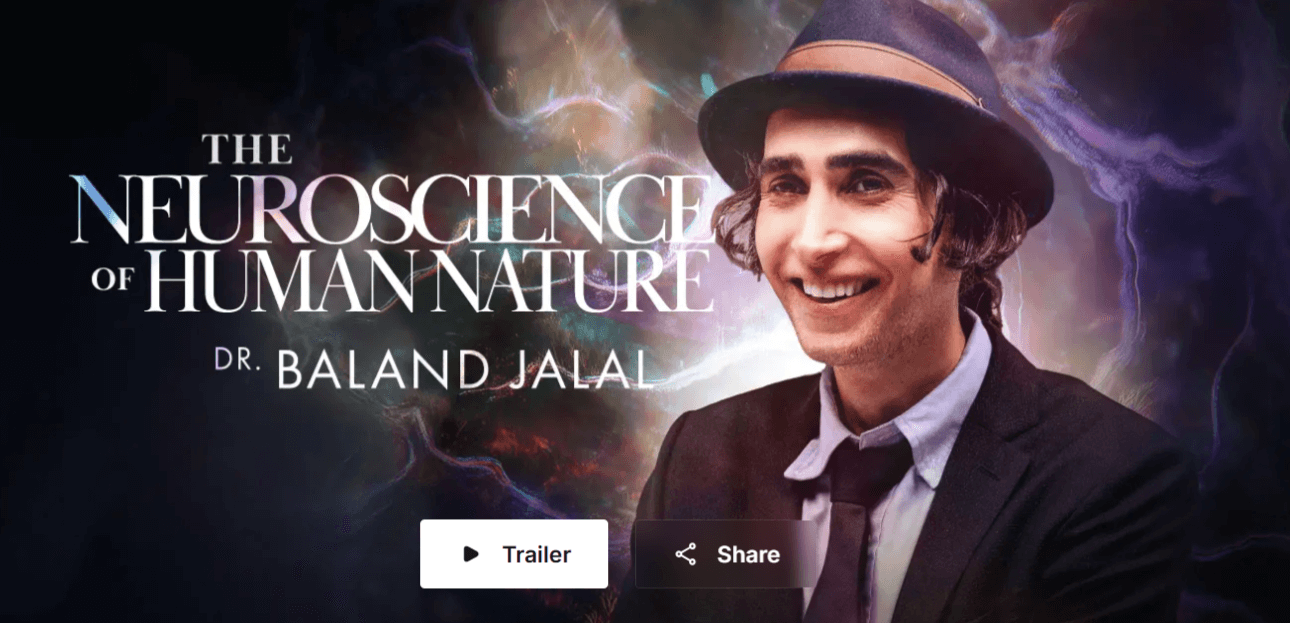
Baland Jalal (Peterson Academy) – The Neuroscience of Human Nature
)
Dr. Baland Jalal
Neuroscientist
In The Neuroscience of Human Nature, an eight-hour course, Dr. Baland Jalal takes us through a fascinating examination of how the brain constructs the self, social cognition, emotion, aesthetic experience, romantic attraction, and consciousness. Through case studies and research, we delve into the complex interplay between neural structures, behavior, and subjective experience, highlighting the brain’s plasticity and the role of unconscious processes. The course ultimately reveals how a deeper understanding of neuroscience can illuminate fundamental aspects of human experience, from creativity and aesthetics to free will and the nature of consciousness itself.
Lectures

- The Constructed Self
In our introductory lecture, Dr. Jalal begins our exploration of the basis of human nature, examining how the brain constructs the self through key regions such as the frontal, temporal, and parietal lobes. Together, we study the interplay between hemispheres, with the left weaving stable narratives and the right questioning them. Through cases of brain damage—such as split-brain patients—we reveal how hemispheric balance shapes a unified consciousness, self-awareness, and how its disruption can spark perceptual delusions or profound personality changes.

- The Social Self
In lecture two, we investigate the concept of the social self and how consciousness develops through interpersonal relationships, using various conditions to illustrate social cognition. The discussion focuses primarily on autism, examining its symptoms, neural basis, and the distinction between cognitive and affective empathy, while also covering psychopathy as a contrasting condition. Dr. Jalal also addresses how brain structures and abnormalities can dramatically influence social behavior and personality, highlighting the complex relationship between neural function and social interaction.

- Emotions in Action
In lecture three, Dr. Jalal explains how brain structures shape behavior and emotion, highlighting cases where tumors near the amygdala or hypothalamus triggered violent or deviant acts that ceased after surgery. We examine the neuroscience of attraction, laughter, and social connection, showing how the limbic system drives emotion and how plasticity lets us reshape neural circuits through attention and rewarding experiences. The session emphasizes that while biology guides us, deliberate practice can cultivate emotional intelligence and social skills.

- The Romantic Brain
In lecture four, we learn about the neuroscience of human attraction, examining how traits beyond visual appearance—such as talents, scent, and hormonal cycles—influence mate choice. We examine higher-order emotions like jealousy, embarrassment, and love, and discuss how jealousy can function as an evolutionary motivator. The lecture concludes by examining the neuroplasticity of romantic love, including how falling in love activates reward centers similar to addiction, and how breaking emotional patterns requires rewiring through new experiences and environments.

- The Believing Brain
In lecture five, we explore the complex relationship between mind and body through various phenomena including placebos, nocebos, and psychological conditioning. The discussion examines how beliefs and expectations can create powerful physiological effects, from false pregnancies to healing responses, with detailed analysis of the neural mechanisms involved. Dr. Jalal also touches on how shared beliefs can influence group behavior. Lastly, he addresses how understanding mind-body connections can be applied to various aspects of human experience, from emotional healing to performance enhancement.

- Beauty and the Brain
In lecture six, we study the neuroscience of aesthetics, examining why humans find beauty in symmetry, contrast, grouping, and other visual principles. We discuss how the brain’s “what” and “where” pathways process patterns and how artists, often unconsciously, harness neural algorithms evolved for survival—such as spotting predators behind foliage—through techniques like isolation, ultra-normal stimuli, and others. Ultimately, Dr. Jalal demonstrates that aesthetic preferences are rooted in neural circuitry, not merely random preference.

- Exceptional Minds
In lecture seven, we look at creativity and genius, examining human abilities in mathematics, metaphor, and artistic expression. We investigate phenomena like synesthesia, savant syndrome, and how brain damage can sometimes enhance specific talents through neural isolation or cross-inhibition. The lecture concludes by discussing the relationship between humor and creativity, the importance of intrinsic motivation for creative flow states, and how optimal challenge rather than easy victory produces the most engaging experiences.

- Conscious Choice
In our eighth and final lecture, we turn to an analysis of the complex nature of consciousness, examining its potential location in the brain and the various components that contribute to conscious experience. We delve into key concepts such as qualia (subjective experiences), the role of different brain regions like the temporal lobes and anterior cingulate cortex, and discuss various theories about why consciousness evolved and whether artificial intelligence could ever achieve true consciousness. Dr. Jalal concludes our course with discussions on free will, addressing both scientific evidence and philosophical perspectives on human consciousness and decision-making.
Course Features
- Lecture 0
- Quiz 0
- Duration 10 weeks
- Skill level All levels
- Language English
- Students 55
- Assessments Yes